Croatoan
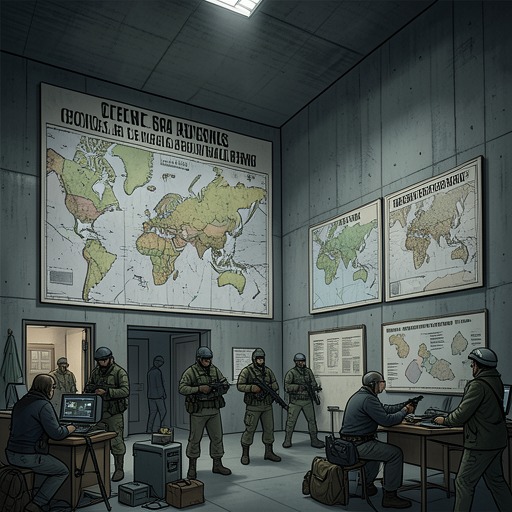
The RookThe Croatoan is the covert supernatural agency that grew out of the Checquy’s first operations in the American colonies. Built by Richard Swansea across a vast and thinly populated territory, it recorded and countered unnatural threats while improvising ways to find personnel and resources. Its eventual absorption into the United States government gave it an enduring institutional position, but not the same authority to recruit powered children by force that the Checquy possessed. The Croatoan’s history is therefore both one of practical adaptation and of a persistent effort to define the bounds of secret power.
Origins and Colonial Mandate
The Checquy sent agents to the New World after an early operative returned from Jamestown convinced that the continent’s supernatural potential required a better-funded investigation. Among those dispatched was Richard Swansea, a secret paranormal agent in Plymouth. His public reputation for piety helped conceal his work in a community where discovery of his records could have put him in grave danger. At the same time, his loyalty to the Checquy shaped his response to the supernatural dangers around the settlement.
Over the next 107 years, Swansea built a resilient American operation that maintained close ties with its parent organization. Known as the Croatoan, it was charged with recording supernatural entities and events throughout the colonies. When a threat arose, its members were encouraged to suppress it and, where possible, send it alive to England for examination. Limited resources often made that impossible: isolated colonial offices formed a thin network across a wilderness, and some menaces had to be terminated rather than captured. Each colony had a Croatoan office, but the agency could not draw on the Checquy’s larger population and resources.
The Croatoan also faced a different political environment from its British counterpart. The colonies offered no dependable governmental authority for acquiring children, and the community’s religious outlook made public association with supernatural abilities dangerous. Swansea observed that powered births seemed more common among Native Americans and sought recruits among them, but the tribes declined, considering their own experience sufficient to meet dangers on their land. Their refusal left the Croatoan to build its forces by other means.
Recruitment and Institutional Methods
Children whose families agreed to apprentice them to local tradesmen could enter the Croatoan with relatively little difficulty. Other children were taken from streets or homes, moved to another colony, given new identities, and educated in the Checquy mission as embodied by the Croatoan. They learned a trade as well as how to protect their community. The system answered the agency’s need for trained operatives, but it did so by overriding the wishes of some families.
Adult recruitment was similarly shaped by necessity. Checquy reinforcements were welcomed, while Swansea recruited locally where he could. Sailors might be pressed into service, and people with newly manifested powers could be rescued from communities likely to treat them as witches. The Croatoan then reeducated them, with Swansea’s personal dedication helping to turn some into operatives. The agency also screened and purchased enslaved people, granting them freedom upon integration. Some members objected to treating formerly enslaved recruits as equals, but those protests subsided when their abilities proved stronger than those of many other operatives. Across these different routes into the organization, the Croatoan’s practical need to assemble a capable force repeatedly tested its claims to serve the public.
Governmental Status and Limits
After the American Revolution, the Checquy concluded that it could not ask King George to fund the American agency and that the Croatoan would have to approach the new government discreetly. Shadrach, a former enslaved person and a Bishop, was selected to make the case. He appeared at George Washington’s home, but the president was away inspecting troops. Martha Washington received Shadrach, heard his account of the Croatoan and its work, and agreed that the young nation could benefit from the agency.
Over tea, Martha and Shadrach negotiated the Croatoan’s absorption into the government. When Washington returned, the United States had a covert supernatural agency. The Croatoan received a large budget and kept a hierarchy modeled in many ways on the Checquy, despite Martha’s objection that a ruling Court conflicted with the new nation’s ideals. Shadrach held firm on maintaining that structure. The agency, however, was denied the right to forcibly take powered children from their families. Its members therefore had to recruit through appeals to duty and responsibility, a method described as nearly as effective as force but more compatible with the Constitution. Its remit was also formally limited: like the Checquy, the Croatoan was not to interfere in nonsupernatural affairs.
Protection, Secrecy, and International Cooperation
The Croatoan grew as the United States expanded, though its numbers did not increase proportionally. The account attributes the comparatively low number of powered births in the continental United States, and the lower frequency of supernatural threats there, in part to protections woven into the land. Swansea suspected that Native American practices had established these protections and that they endured even as the tribes diminished. The continent was not free of danger: the Croatoan faced, among other threats, the Irregularities, the Cult of the Estrangement, the Horseman of Famine, and the Rattling God. But the agency’s work took place across a much larger territory with fewer members than the Checquy’s.
Despite the formal separation imposed by the two governments, the Croatoan and the Checquy maintained close relations. They communicated regularly, and members of one organization visited the other across the ocean. In 1850, the Sororitas Pact made those ties formal. It established the List, a record of threats each organization considered especially serious, and required immediate sharing of developments involving a listed threat. The pact also committed the organizations to extradite transgressors and never to take part in a war against the other’s country.
The organizations also cooperated in the field. During the American Civil War, the Croatoan called in Checquy reinforcements when gigantic mollusks rose again amid the violence. The Checquy later sought American assistance when demons entered through a portal in Hong Kong, and in 1989 the two agencies coordinated against animated dead in Hawaii, which did not share the continental United States’ reported supernatural protection. These joint operations strengthened an alliance founded on shared work rather than identical powers or jurisdictions.
The Croatoan in the Present-Day Plot
The Croatoan remains a close ally, though it is smaller than the Checquy and responsible for a much larger territory. Its representative, Bishop Shantay Petoskey, visits Britain as an observer. The Sororitas Pact permits Croatoan representatives to attend manifestations, a right that becomes relevant when Petoskey accompanies Myfanwy Thomas to a Checquy operation. Petoskey is prepared to enter the danger alongside Myfanwy, but Myfanwy objects that harm to a Croatoan Bishop on a Checquy operation could have serious consequences. Their exchange presents the alliance not as a distant treaty alone, but as a relationship enacted through shared observation and personal risk.
The Croatoan’s status also makes it important to the threat posed by the Grafters. When Myfanwy considers what would happen if the Checquy fell, she recognizes that the Grafters might then be able to take on the Croatoan without British support. Later, she informs Graaf Ernst von Suchtlen that a Grafter operative had been captured in Los Angeles. Von Suchtlen explains that Gerd had arranged for an expendable operative to be discovered in the United States as a diversion: the plan was to distract the Croatoan and prevent it from sending reinforcements to the Checquy. This revelation shows that the Croatoan’s alliance has strategic force, and that an enemy can target the relationship by manipulating where the American agency directs its attention.
When Myfanwy raises the possibility of joining the organizations, she makes clear that she cannot authorize a merger herself. The proposal would have to go before the Checquy Court, and the Croatoan would also have to be involved. The Croatoan thus remains an independent partner whose consent matters to decisions about the future of both organizations.
Significance
The Croatoan’s development contrasts two ways of building a secret protective institution. In the colonies, Swansea’s agency acquired children, rescued people endangered by their powers, recruited adults, and made use of resources available under severe constraints. Once incorporated into the United States government, it retained a hierarchy and a covert mission but lost the Checquy’s authority to seize powered children. Its history makes the limits of that authority visible: shared purpose does not erase differences in law, political ideals, or recruitment practice.
The agency’s relationship with the Checquy is consequently both close and bounded. The Sororitas Pact provides common procedures, the List supplies a mechanism for sharing urgent intelligence, and joint operations translate the agreement into action. Yet each organization remains accountable to its own government and must participate in any proposed merger. In the present-day conflict, that balance becomes a vulnerability as well as a strength: the Croatoan can support the Checquy, but its attention can also be diverted. Its role gives the novel’s secret world a transatlantic structure, where protection depends not on one all-powerful agency but on institutions that cooperate while preserving their distinct authority.